The Deadliest Dinosaurs (and Prehistoric Reptiles) of the Mesozoic Era
Some dinosaurs were especially deadly, sporting huge teeth, sharp claws, and (occasionally) even the ability to outwit their prey. Here's a list of the 10 deadliest dinosaurs, pterosaurs, and marine reptiles that ever lived. If you see one of these monsters on the street--RUN!
1. Tyrannosaurus Rex

We'll never know if Tyrannosaurus Rex was particularly fiercer or scarier than other, less popular tyrannosaurs like Albertosaurus or Alioramus--or even whether it hunted live prey or feasted on already-dead carcasses. Whatever the case, there's no question that T. Rex was a fully functional killing machine when circumstances demanded, with its five- to eight-ton bulk and huge head studded with numerous, sharp teeth. (You have to admit, though, that its tiny arms lent it a slightly comical appearance.) Read more about Tyrannosaurus Rex
2. Utahraptor

Deinonychus and Velociraptor get all the press, but for sheer killing ability no raptor was more dangerous that Utahraptor, adult specimens of which weighed almost a ton. With Utahraptor, the characteristic, single curved claws of the raptor family attained "Friday the 13th"-worthy sizes, kind of like the difference between a medieval broadsword and a Swiss army knife. Weirdly, this giant-sized raptor lived 50 million years before its more famous descendants, which were considerably smaller (but a lot faster). Read more about Utahraptor
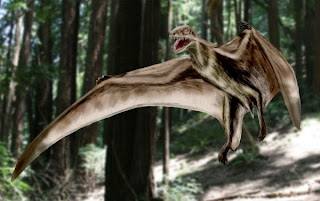


3. Jeholopterus

Jeholopterus is a more controversial inclusion than the other reptiles on this list--not because it was a pterosaur rather than a true dinosaur, but because paleontologists disagree about its basic anatomy. The researcher who "diagnosed" Jeholopterus (based on a single, squashed, but near-intact fossil) concluded that this pterosaur had sharp fangs, and speculation ensued that Jeholopterus made its living by sucking the blood of ponderous sauropods like a Jurassic vampire bat. Maybe--but then again, maybe not. Read more about Jeholopterus
4. Kronosaurus

Any marine reptile named after Kronos--the god of Greek myth who devoured his own children--must have been one bad character. Simply put, Kronosaurus was much, much bigger than a modern Great White Shark, and it had much, much bigger (and scarier) teeth. This plus-sized pliosaur probably ate anything unlucky enough to swim across its path, ranging from fish to squids to other, smaller marine reptiles--and perhaps even the occasional dinosaur that ventured too close to the water's edge. Read more about Kronosaurus
5. Troodon
Deadliness isn't simply a matter of size or armament. Troodon weighed only about 150 pounds (about as much as a full-grown human), and it didn't have particularly sharp or scary-looking teeth. What set this theropod apart was its relatively big brain, compared to other carnivorous dinosaurs of the late Cretaceous period, and its presumed ability to hunt in packs at night (the giveaway is its large eyes). The bottom line: four or five alert Troodon might have been equivalent in danger to one full-grown Tyrannosaurus Rex. Read more about Troodon
6. Allosaurus

It can be, well, dangerous to speculate about how many individuals existed of a given genus, based solely on fossil remains. But if we agree to make that leap, then Allosaurus was a deadlier predator than the (much later) Tyrannosaurus Rex--numerous fossils of this fierce, strong-jawed, three-ton theropod have been found across the western U.S. As deadly as it was, though, Allosaurus wasn't very smart--a group of adults perished at a single quarry in Utah, mired in deep muck as they salivated over already-trapped prey. Read more about Allosaurus
7. Sarcosuchus

Better known as the SuperCroc, Sarcosuchus was about twice as long and 10 times as heavy as the largest crocodiles living today--making it the crocodilian equivalent of the marine reptile Kronosaurus, which was 10 times the weight of a modern Great White Shark. In fact, this Cretaceous crocodile may have been deadly enough to lunge suddenly out of a lake or river, snag a full-grown sauropod by its long neck, and drag it kicking and screaming back into the water for a quick lunch. Read more about Sarcosuchus
8. Excalibosaurus

If this ichthyosaur ("fish lizard") sounds vaguely familiar, that's because Excalibosaurus was named after Excalibur, King Arthur's mythical sword. Like a modern-day swordfish--only a lot, lot bigger--Excalibosaurus used its long, pointed, tooth-studded snout to spear prehistoric fish for dinner and keep others of its kind at bay. Weirdly, the top half of Excalibosaurus' jaw protruded a full foot beyond its lower jaw--which might (if they hadn't been so terrified) have prompted some cruel teasing from its fellow marine reptiles. Read more about Excalibosaurus
9. Giganotosaurus

During the Cretaceous period, the dinosaurs of South America tended to be bigger and fiercer than their counterparts elsewhere on the globe. Exhibit A is Giganotosaurus, an eight-ton, three-fingered, romping, stomping predator whose remains have been found in close proximity to those of slaughtered Argentinosaurus, one of the biggest dinosaurs ever to walk the earth. The inescapable conclusion: Giganotosaurus was one of the few theropods capable of taking down a full-grown titanosaur adult. Read more about Giganotosaurus
10. Majungatholus

Majungatholus has been dubbed the "cannibal dinosaur" by the press, and even though this may be overstating the case, that doesn't mean this carnivore's reputation is entirely unearned. The discovery of ancient Majungatholus bones bearing ancient Majungatholus tooth marks is a good indication that these one-ton theropods preyed on others of their kind (possibly after they were already dead), though they probably spent most of their time terrifying the smaller, quivering dinosaurs of late Cretaceous Africa. Read more about Majungatholus
BONUS
Spinosaurus

If it weren't for one tell-all feature, Spinosaurus might have been indistinguishable from any other large theropod stalking the swamps of the Cretaceous period. That feature, of course, was the extensive, fin-shaped sail on its back, a thin flap of skin supported by sharp needles of bone that protruded from Spinosaurus' vertebrae. (See 10 Facts About Spinosaurus and a gallery of Spinosaurus pictures.)
Why did Spinosaurus have this strange-looking sail? The most likely explanation is that this structure evolved for cooling purposes in the hot northern African climate in which Spinosaurus lived (a bit like the big, floppy ears of African elephants). It may also, as a byproduct, have been a sexually selected characteristic--perhaps male Spinosaurus with bigger sails had more success mating with females.
By the way, paleontologists now believe that Spinosaurus was the largest carnivore that ever lived--outclassing even Tyrannosaurus Rex by one or two tons. Fortunately--or unfortunately, if you happen to be a movie producer--these two dinosaurs didn't share the same time or territory, T. Rex living tens of millions of years later in North America, not Africa.
By the way, paleontologists now believe that Spinosaurus was the largest carnivore that ever lived--outclassing even Tyrannosaurus Rex by one or two tons. Fortunately--or unfortunately, if you happen to be a movie producer--these two dinosaurs didn't share the same time or territory, T. Rex living tens of millions of years later in North America, not Africa.